Chronicles of the Commercial Visible, Part III of VI
Improvements to the Machine

In Parts I and II of Chronicles of the Commercial Visible, we were introduced to the founding men who invented, manufactured, and sold the Commercial Visible: Richard Uhlig and William Bell Baldwin. We were also introduced to several companies associated with her manufacture and sales, including Commercial Typewriter Company, Siegel-Cooper & Company, Commercial Visible Typewriter Company, and Index Visible Typewriter Company. With this last company we were introduced to her brother machine, the Index Visible, and learned of his short life. Now we come back to the main line of the story at a time of great change to both the machine and her associated companies.
Uhlig's Departure

Stepping back a year or two to 1901, the manufacturing concern, the Commercial Typewriter Company, was undergoing some changes. That year, Uhlig resigned his role as vice president “to devote himself to the work of invention” (“Uhlig, Richard William”, 1906). This would not have been the first time Uhlig had stepped down from a higher role. In 1899, he stepped down as superintendent, but did not sever ties with the company, and it may have only been temporary (see article to the left) (“Commercial Typewriter Co.”, 1899). This time would be different. While Uhlig’s departure from the Commercial Typewriter Company may or may not have impacted the Index Visible and Commercial Visible typewriters, it certainly impacted the world of typewriters as a whole; Uhlig was free to pursue other projects, and became one of the most prolific and impactful typewriter inventors in history.

According to The National Cyclopaedia of American Biography (“Uhlig, Richard William”, 1906), Richard Uhlig was born in 1859 in New York to immigrants from Walkenstein, Saxony, who came to the US just five years before his birth. They eventually resided in Strattonport, which became College Point, the location listed on Uhlig’s first typewriter patent (Uhlig, 1897). Uhlig left high school to assist with his “widowed mother” by getting a job at Locke & Co. of Whitestone. After moving through the company, he “formed a partnership with his brother-in-law, Michael Tries, to manufacture novelties, baskets and florist’s supplies” (“Uhlig, Richard William”, 1906, p. 418). Unfortunately, the business failed, so he sought employment under Mr. Wilhelmi, with whom he had previously been employed. Through this period, he patented novelties such as pencils, pencil sharpeners, and fountain pens. These early patents were granted to the Eagle Pencil Co., where he was employed for a year in 1882 in order to manufacture his own inventions before he handed over the patents to the company. This early experience seemed to have set him up to eventually establish his own company. The article goes on to report:
In 1890, he organized the Uhlig Cash Register Co. to manufacture his indicator and register, the prototype of the various machines now on the market. He was also founder of the Automatic Vending Machine Co., which manufactures most of the automatic slot machines now used, on the basis of designs originated by him. Soon after the introduction of typewriters, he decided to make these machines his specialty. . . . He has been working on the problem of a perfect commercial typewriter for over twenty years, and his inventions are secured by no less than 400 claims. . . . After yielding so large a part of the products of his inventive genius to others, in 1898 Mr. Uhlig established a manufactory of his own at Carlstadt, N. J. equipped with special tools and machine appliances, for the purpose of producing his improved commercial visible typewriter. He continued vice-president of the company until 1901, when he resigned to devote himself to the work of invention. (“Uhlig, Richard William”, 1906, p. 418).
And that devotion paid off. On May 12, 1902, Uhlig applied for another typewriter patent for the interesting and beautiful Emerson typewriter, which was granted US Patent 717,144 on December 30 of that year, and was assigned to Henry C. Adams (Uhlig, 1902). Uhlig invented other successful models such as the Atlas and the Allen (Messenger, 2011b), but the work that led to Uhlig’s position of honor as one of the most influential typewriter inventors in history was for his famous Underwood typewriter.

Visible Typewriters Company
After Uhlig's departure, in September 1901, a new model of the Commercial Visible typewriter was released, the Model 6. This was advertised and sold by yet another new company, the Visible Typewriters Company (Visible Typewriters, 1901; Geyer, 1902a). It is with this change that a new inventor entered the stage: Carlton C. W. Peck of Rutherford, NJ. Carlton Peck was responsible for one of the new features advertised on the Model 6, a ruling attachment that looked like an attached pencil holder, which enabled the user to draw lines across the page both horizontally and vertically (Peck, 1903). This was particularly useful for another new feature offered on the Model 6: the ability to write up and down the page vertically (Pitman, 1902). Peck had filed for the pencil holder patent on January 18, 1902, and waited a year and a half for US Patent 734,937 to grant on July 28, 1903. Upon review of the witnesses of Peck’s patent, the name of another man who also recently entered the story appeared: Mr. Alex M. Fiske, the selling agent of the Index Visible typewriter.
Patent figure for Peck's pen holding device
Visible Typewriters Company filed a certificate of incorporation as a manufacturing company in New Jersey on March 20, 1901, with their principal office listed at 47 Donaldson Ave., Rutherford, NJ (Secretary of State, 1902). The company was listed to manufacture, buy, sell, and deal in typewriters and typewriter supplies. The incorporators were J. Bliss Dudley of New York, Carlton C. W. Peck of Rutherford, NJ, and Robert B. Bowman of New York (Certificates, 1901). J. Bliss Dudley seems to have provided primary funding for the company since, at the time of incorporation, he held 90 shares versus Peck and Bowman’s 5 shares each. The following year, the company was listed in Polk’s New York directory (Polk, 1902) as a New Jersey company with an office at the same 300 Broadway as other companies associated with the Commercial Visible, and listed three familiar directors: you just met secretary Carlton C. W. Peck and recently heard of treasurer Alexander M. Fiske. The third director, the president, was none other than Mr. William Bell Baldwin, the owner of the patents of the Commercial and Index Visible typewriters, and director of the Commercial and Commercial Visible Typewriter companies.
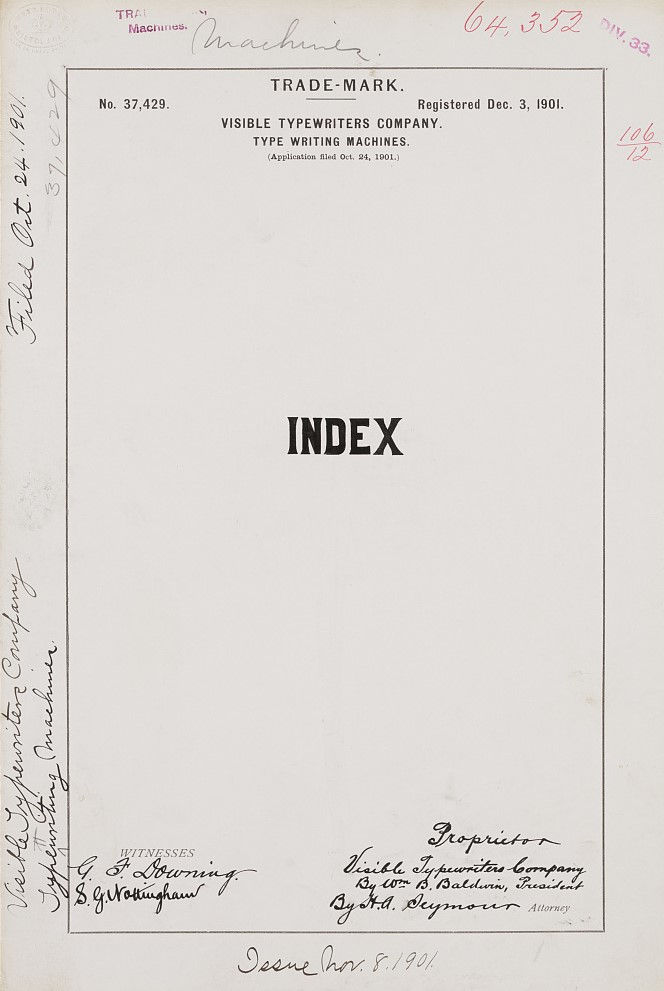
It is clear that Visible Typewriters Company, Index Visible Typewriter Company, and Commercial Visible Typewriter Company were connected, likely operating as the same company, but perhaps different legal entities. We are able to draw a direct link between the Index Visible typewriter and the Visible Typewriters Company through a trademark registered in 1901 (US Patent Office Trademarks, 1901) (see registration form to the left), and the Visible Typewriters Company does not seem to have replaced either the Commercial Visible or the Index Visible Typewriter companies. Both latter companies were still in operation at the time of the former's incorporation. The former paid New Jersey taxes in 1901, and both latter companies were listed in the 1901 New York City directory at 300 Broadway with managers William B. Baldwin, Carlton C. W. Peck, and Robert B. Bowman (Baird, et. al, 1902; Trow Directory, 1901, pp. 102 & 234), an address that was shared by the Visible Typewriters Company in 1902, was listed with directors Baldwin, Peck, and Fiske, and was also listed as a company of New Jersey (Trow Directory, 1902, p. 540).
Peck Book-o-Type

Back to the typewriter itself, flipping open the catalog for the new Commercial Visible No. 6, we find another new feature advertised: the “Peck Book-o-Type”, a trademarked name for a book writing attachment that was filed by Visible Typewriters Company in December 1902 and granted February 3, 1903 (US Patent Office, 1903; US Patent Office Trademarks, 1903). This attachment enabled a user to type directly into books from the convenience of their own typewriter (Visible Typewriters, 1901, p. 12). Coupling this new attachment with the Model 6’s new ability to type vertically and to draw lines meant that if potential customers wanted a typewriter for normal office use and a writer for bookkeeping, one would only have to purchase and become familiar with a single machine. According to a 4-page ad, the device provided a better book-typing experience than typewriters specifically made for printing into books, suggesting that a potential customer would not have to sacrifice quality for convenience (Geyer, 1902c). Although I was unable to find any patent confirming the inventor of this attachment, given that Carlton Peck had invented the Ruling Attachment, it seems likely that this book-writing attachment bearing his name was also invented by him.
Coincidentally, the following year, the Commercial Visible Typewriter Company opened an office in Boston and hired as manager C. W. Larkin, a man who had formerly worked for the Elliott & Hatch Company (Geyer, 1902e). Elliott & Hatch had merged with the Fisher Book Typewriter Company later in 1903, and manufactured the well-known Elliott-Fisher Book Typewriter. As that would have been a direct competitor to the Commercial Visible Typewriter with the Book-o-Type attachment, it was probably good fortune to have hired this man on before competition ramped up.

Summary of Part III:
Improvements to the Machine
As you can see, the years 1900 through 1903 brought in a revamped machine after her inventor left the scene. In Part III we finally met Richard Uhlig, the inventor of the Commercial Visible, just when he decided to leave the company to move on to bigger and better things. We learned of the many improvements made to the typewriter, largely related to new attachments offered with the new Model 6. Through this exploration, we learned of a new inventor who contributed to the machine, Carlton C. W. Peck, and found out that Alex M. Fiske is a name that will be interlinked with the story more than we realized. We will now pause again to explore the lives of these two new caretakers of the Commercial Visible typewriter.
References
Due to the length of the reference list for this six part series, it has been posted separately. Please see the article titled "Chronicles of the Commercial Visible, References" for a complete list of all sources you will encounter in the text, and from which the pictures were pulled.


Comments