Chronicles of the Commercial Visible, Part V of VI
Dissolution and Succession
In Parts I - III of Chronicles of the Commercial Visible, we were introduced to the Commercial Visible typewriter and her early life, learned of her original directors and inventor, discovered her brother machine, the Index Visible, and were introduced to several of her associated companies. In Part IV, we explored the background of new directors of those companies, Alex M. Fiske and Carlton C. W. Peck, the latter being an inventor in his own right. In Part V we will return from that brief hiatus back again to the main story, re-entering in the year 1902, which marked the beginning of the end for the Commercial Visible and her associated companies. As part of this ending, we will meet a new player, another inventor and company man, will discover family connections, and will be introduced to endeavors which reached beyond the Commercial Visible typewriter to enable her players to make a name for themselves beyond the business she provided. We turn now to that fateful year of 1902, starting with the end of the story for the original director, William Bell Baldwin.
Baldwin Passes Away

As you may have noticed, around the year 1902 there seemed to have been quite a few changes for the Commercial Visible and Index Visible typewriters. Although the Commercial Visible Typewriter Company was still around, the Visible Typewriters Company was the one selling the typewriter, and it seems that Peck’s and Fiske’s names were everywhere. The Index Visible Typewriter Company had dissolved in 1902, and it seems the Index Visible stopped being sold altogether. Uhlig had left the Commercial Visible and Index Visible behind the previous year, in 1901, and that was not the last of the changes occurring around the turn of the century for these machines. On February 1, 1902, the remaining original director for the Commercial Visible typewriter, William Bell Baldwin, passed away (Geyer, 1902a).


In January 1901, the same year that William Baldwin had become president of the Visible Typewriters Co., the same year that Uhlig had left, and the same year that the Commercial Visible Model 6 was released, William announced his engagement to a woman named Bertha Sanborn. They had set the wedding date for February 1902, but at the end of 1901, Baldwin had developed a wound which resulted in blood poisoning, and on January 4 he was taken to the hospital (“Clergyman Dies”, 1902; “Hospital Bridegroom”, 1902; “Dr. Wall’s”, 1902; “Pastor”, 1902). At the time, Baldwin was living with his mother at No. 126 West 129th St, New York, and it was she who suggested to Bertha that the two should be married in the hospital in case anything should happen during surgery. So on January 12, 1902, Baldwin was wheeled on a reclining chair to the private chambers of Dr. George Wall, the chaplain at Presbyterian Hospital, and the two were married. According to the newspapers, William managed just enough energy to be able to respond during the ceremony. After the wedding, the chaplain who had been weak from his own condition, suddenly, but not unexpectedly, passed away. In the next few weeks, Baldwin had an operation for carbuncle, which was successful, but the blood-poisoning had already set in. On February 1, 1902, at 34 years old, with his new bride by his side, William Bell Baldwin departed from this world (Geyer, 1902a; “Died”, 1902; “Obituary”, 1902). The funeral took place on February 8, 1902, and we find among the pall-bearers, Mr. Carlton C. W. Peck (“W. B. Baldwin’s Funeral”, 1902).
Walter S. Hallock

In the midst of this sad turn of events, about a week after Baldwin’s wedding, and a week before his untimely death, we find that another inventor was continuing to improve on the design of the Commercial Visible typewriter. On January 18, 1902, another inventor, Walter S. Hallock, also of Rutherford, NJ, applied for a patent on the paper feed device of typewriters to enable paper to be inserted more easily between the rollers (Hallock, 1904). The picture in the patent had a strong resemblance to the Commercial Visible typewriter, suggesting that this patent was intended for that machine. The new directors of the typewriter’s new company, Carlton C. W. Peck and Alex M. Fiske, had signed as witnesses, lending further evidence to that suggestion. US Patent 760,066 was granted on May 17, 1904.

So who was Walter S. Hallock, what relationship did he have to Peck and Fiske, . . . and why does his name ring a bell? Thinking back to the early lives of Peck and Fiske, you may remember that one of Carlton Peck’s sisters was to be known as Mrs. W. S. Hallock. Could that be a coincidence? With a little more research, I was able to determine that Grace Adella was the name of Carlton’s sister, and that she was married to a man named Walter S. Hallock (US Census, 1880a; US Census, 1900; ‘Grace Amelia Hallock’, 1909). Walter was, in fact, Carlton Peck’s brother-in-law.

Walter S. Hallock was born in Connecticut in May 1862 (US Census, 1900). 21 years later, around 1883, Walter and Grace were married (US Census, 1900). 15 years after that, in 1898, we have evidence that Walter was working in typewriters at 320 Broadway, New York City, the same year, location, and business address as Carlton (a year before the Franklin typewriter company was located at that site), and the same year that Alex M. Fiske was working in machinery at 132 Nassau (Brown, 2003; Trow Directory, 1898). In 1900, the Hallocks lived at 47 Donaldson Ave. in Rutherford, NJ, with Grace’s widowed mother, Elizabeth, their two daughters, Grace and Jessie, Grace and Carlton’s single brother Charles, widowed sister Emma Dunham, and Emma’s four daughters, Sarah, Flora, Julia, and Beulah (US Census, 1900) - basically everyone in Grace’s family except Carlton.

47 Donaldson Avenue is another address that may sound familiar. Visible Typewriters Company had filed a certificate of incorporation in 1901, and listed this very same address as the primary office, and Carlton Peck as the agent. It seems the house still exists, and appears to have been a family house, so it seems that the original office for Visible Typewriters Company was actually a residence. The modern day house was built in 1898 (Zillow, 2025), the same year that we found Carlton Peck and Walter Hallock working out of 320 Broadway in New York City.

Research led to the fact that the family typewriter business did not stop with Carlton and Walter’s generation. In 1909, Grace Amelia Hallock, Grace and Walter’s daughter, married a man from Texas named Lester B. Stroud, who was himself a typewriter dealer in Rutherford, NJ (‘Grace Amelia Hallock’, 1909). It seems the families knew each other at least five years earlier. Lester’s maternal grandparents (Stroud Family Tree, n.d.) visited Grace’s parents or maternal grandparents. July 29, 1904, the local interest section of The Meriden Daily Journal mentioned:
Mr. and Mrs. W. Bingham of Howard avenue have returned from their vacation in New Jersey, where they were the guests of Mr. and Mrs. Hallock and their grandson, Lester B. Stroud. (Of Local Interest, 1904, p. 2)
But we digress. We will come back to the next generation a bit later. Now that we are aware of the deeper link between Peck and the Visible Typewriters Company, we will return to the Commercial Visible Typewriter Company.
Commercial Visible Typewriter Company Dissolves in New Jersey

As you have read, the departure of Uhlig and the death of Baldwin led to a natural change of guard in the Commercial Visible Typewriter Company and the Visible Typewriters Company. Changes in the selling strategies of the two main products, the Commercial Visible and Index Visible typewriters, may have resulted from this turnover. For example, in 1902, the Commercial Visible typewriter, Model 6, was placed on the British market under Gem Supplies Co., located at 121 Newgate St., London, E.C. under the management of Mr. J. R. Greenhalgh, a man who had experience working with the Yost typewriter company (Pitman, 1902). It seems that the Visible Typewriters Company was taking over as the primary selling agent for the Commercial Visible typewriter in the United States, and was already the primary selling agent for the Index Visible typewriter. Combining this fact with the departure of Uhlig and Baldwin, it is not surprising that on January 6, 1903, the charter for the Commercial Visible Typewriter Company was declared null and void by proclamation in the state of New Jersey (Secretary of State, 1904; State, 1903; Charters, 1911). If you remember, this was the same year that the New Jersey charter for the Index Visible Typewriter Company was also dissolved (State of New Jersey, 1903). That said, it does not seem that the Commercial Visible Typewriter Company of New York dissolved. Advertisements for the company stated that they were moving into larger quarters and had expanded into Baltimore (Kellogg & Co., 1903; “Into New Quarters”, 1903).
Visible Typewriters Company Goes Bankrupt

What may be surprising is the apparent end of the Visible Typewriters Company. Thanks to a picture from the AntiKeyChop website of Mr. Greg Fudacz, we discover in the header of a letter signed by C. C. W. Peck, sent on behalf of the Commercial Typewriter Company, written on May 13, 1904, that the Visible Typewriters Company had a Receiver who sold the typewriters, parts, and tooling of the Visible Typewriters Company to the Commercial Typewriter Company (Fudacz, n.d.). We also find a November 1904 ad by the Erlie Typewriter Company in New York selling the Commercial Visible for half price (“Typewriter Tip”, 1904). The same deal was seen in the same journal multiple times into 1905, where we find that they made a deal to ship directly from the manufacturer (The People, 1905). We also see in 1905 an ad by the Commercial Typewriter Company itself, now also selling the machine for half price (Commercial Visible, 1905). It seems clear that the company was trying to liquidate the remaining stock. Our theory is validated by the newspapers on March 27, 1905, where we find Visible Typewriters Company listed as bankrupt (Bankruptcy Notices, 1905; Fudacz, n.d.), and on April 6, 1905, their assets, including 56 Commercial Visible Typewriters, about 40 second hand typewriters of various makes, and small pieces of office furniture, went for auction (Bankruptcy Auction, 1905). In January 1906, a second bankruptcy auction for the company was posted, to sell off the remaining four second-hand Commercial Visible typewriters and “certain outstanding accounts” (Bankruptcy Auction, 1906). Meanwhile, Walter S. Hallock was still living in Rutherford, NJ, with Grace and their children, and was still working in typewriter manufacturing, but had moved away from his in-laws, living instead with a man from Germany, Henry A. Van Hartz, who was listed as working in bookkeeping (NJ Census, 1905). Perhaps as the Visible Typewriters Company was failing, the Hallocks wanted to move away from the original office-house to find their own way. That said, it seems that Hallock did continue to work for his brother-in-law.

As you may have noticed, one of the resources that greatly assisted this research was Greg Fudacz’s site, The Antikey Chop, and more specifically his page on the Commercial Visible (Fudacz, n.d.). I tend to agree with his theory:
I theorize that the reorganization of the company and resulting name change may have been nothing more than some legal wrangling at a final attempt to save a failing company. When the company was officially listed as bankrupt on March 27, 1905, it was under its original name so maybe the new company was absolved of any legal accountability. (Fudacz, n.d.)
The only alternative explanation I would mention is that, while Fudacz surmised that the Commercial Typewriter Company was a new name for the same company, it is likely that this was the original manufacturing company founded by Uhlig and headed by Baldwin. Since the company started liquidating stock as early as 1904, it is likely that they stopped manufacturing fully new Commercial Visible typewriters around that time as well, moving to rebuilding the machines instead. We find an ad by the Commercial Typewriter Company in 1906 for the Commercial Visible typewriter, sold at half price, and the ability for customers to ask for a catalog of rebuilt machines of all makes and models (S. S. McClure, 1906), meaning that if this alternative explanation is true, it’s possible this is when the company decided to move to rebuilt machines in general.

As previously mentioned, although the Commercial Visible Typewriter Company had dissolved its charter in New Jersey, it did not seem to have dissolved in New York, and was still listed in Trow’s 1906 New York directory, along with Commercial Typewriter Company, both listed at 257 William, NY, with named managers Fiske and Peck (Trow Directory, 1906, p. 154). In this directory, and in 1907, we find a third company, the Mercantile Manufacturing Company, listing Fiske and Peck as president and secretary (Trow Directory, 1906, p. 466; Audit Company, 1907). Among the list of directors was someone named W. C. Hallock, which could have easily been a misprint of W. S. Hallock, suggesting that Hallock was still working for his brother-in-law. I couldn’t find much about the Mercantile Mfg. Company, other than that another typewriter patent had been assigned by its inventor, Charles E. Peterson of Brooklyn, NY, to this company (Johnson, 1906). I note the Mercantile Manufacturing Company only because it may have been part of the grand scheme as changes were occurring across the Commercial Visible’s enterprises, but not much seems to have been written about that company.
Typewriter Clearing House Company

Two years later, in 1908, the Commercial Typewriter Company was listed at a new address, 82 Duane St., New York. At that time the company was primarily advertising rebuilt typewriters, but continued to capitalize on the fact that they were the “manufacturer of the “Commercial” visible typewriter” (“Classified Directory”, 1908, p. 138). One advertisement was focused on the company’s export business, listing their primary overseas office as 15 Mansion House Chambers, London, England, perhaps indicating past ties that had been made when the Commercial Visible went overseas. In another ad for the Commercial Typewriter Co. posted in the same magazine, rebuilt typewriters took center stage, and the Commercial Visible was not mentioned (“Classified Directory”, 1908, p. 195). It is fun to note that one of the advertised rebuilt typewriters was an Underwood, which if you remember, had also been invented by Uhlig. It seems the changes Fiske and Peck wanted to implement were taking effect: they cut ties with the old Commercial Visible typewriter to make way for the rebuilt market. To accompany the beginnings of this new era, on September 14, 1908, Carlton and Carrie gave birth to a son, Elwood Carlton Peck (Stroud Family Tree, n.d.).

It was in April 1909 that direct evidence existed in an advertisement that finally brought in this new era. The ad revealed that the Typewriter Clearing House Company, was located at 82 Duane St., New York City, and called itself the successor to the Commercial Typewriter Company (Typewriter Clearing House, 1909). Note that this did not necessarily mean that the Commercial Typewriter Company changed names or was closed. In 1915, The Industrial Directory of New Jersey still listed the Commercial Typewriter Company as one of the “principal manufacturing plants now in operation at Carlstadt” (Low, 1915, p. 87-88), but suggests that they may have changed management and that this new business was to take over the primary function of the business previously at that location. Of course, this also means that either the factory of the Commercial Typewriter Company never left Carlstadt, which might suggest that when the Index Visible moved its manufacture to Staten Island, it was under a different concern, or that the company had left and later returned, which would be supported by the fact that they stopped rent on their original factory site around 1900.

Looking through some magazines, we discover from The American Stationer in November 1908 that the Typewriter Clearing House Company had been incorporated in Great River, Suffolk County, New York (Trade Items, 1908). The directors were Charles W. Larkin of 82 Duane St., who you may remember as the manager hired by Commercial Visible Typewriter Company to run the newly opened Boston office in 1903, secretary J. C. Moesch, and none other than president Alexander M. Fiske. Like the Commercial Typewriter Company, the Typewriter Clearing House Company had been incorporated in New Jersey (Trow Directory, 1909). Also like the latter years of its predecessor, this new company’s stated purpose was to sell second hand and rebuilt typewriters of many well known brands (La Typewriter, 1909). Reporting $10,000 capital for incorporation, about 10% or less of a typical manufacturing company of that time, it is clear that they were not intending to open a manufacturing facility to build new machines (Trade Items, 1908; Great River, 1908). The meager capital likely went towards an office, some staff, and as the name suggests, a clearing house of inventory of used typewriters purchased from both companies and individuals that the staff would refurbish. And the re-sale of those refurbished machines would not need to serve a new-machine-hungry domestic market. The company operated almost exclusively as an export business. Apparently, customers abroad were more likely to purchase older typewriter models that had been rebuilt and repaired than customers in the American market who preferred off-the-manufacturing-line models. The company had major markets in Russia and Latin America, and also exported to Australia, Philippines, Cuba, Spain, Germany, and Belgium, among others (Best, 1912).
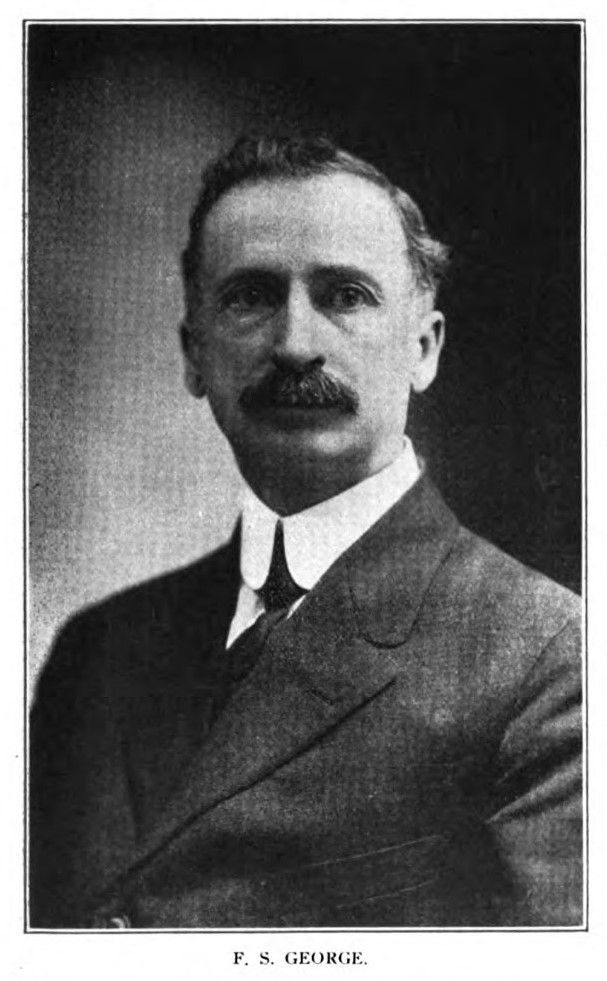
Fiske and Moesch were still president and secretary in 1910 when the company moved from 82 Duane in New York with a New Jersey main office, to 377 Broadway in New York with a New York main office (Trow Directly, 1910; Trow Directory, 1911; Shaw, 1910; For Sale, 1910). Around that time, the company started buying up other typewriter businesses, including Fay-Sholes Typewriter Company, W. H. Alexander Typewriter Company, and R & G Typewriter Company (Best, 1912). With the purchase of R & G Typewriter Company of 229 Broadway, the business also took on a change in management. In 1910, a man named Frank S. George, who had patented the Handy Check Protector (US Patent 971,601), moved to New York and purchased the R & G Typewriter Company of 229 Broadway. Mr. George had previously been selling and repairing typewriters for various companies, including Remington, and right before coming to New York, had ventured out on his own to sell check protectors, likely those of his own invention. The purchase of R & G proved to be a successful business decision. When that business was absorbed by the Typewriter Clearing House Co. around 1911, Frank George became the president and treasurer of the new conglomerate, a man named Leonard Taylor was named secretary by 1912, and the directories stopped listing Alex Fiske as associated with the company (Trow Directory, 1912; International Typewriter, 1912). By 1914, two years after Fiske had left the company, Typewriter Clearing House had moved again, this time to 225 Fulton Street (Exporters’ Encyclopaedia, 1914), and by 1918 the company had moved to its seemingly final resting place at 27 Pearl St. (White, Orr & Co., 1918).
In Part V of Chronicles of the Commercial Visible, we mourned the untimely passage of William Bell Baldwin, took notice as the manufacturing lines of the Commercial Visible were silenced, and were saddened when the Visible Typewriters Company went bankrupt. We also took joy in the birth of the children of the directors of the Commercial Visible, met a new inventor, Walter S. Hallock, and discovered that the typewriter business was really a family affair. Even as the Commercial Visible passed into history, there was new life as her associated businesses turned to rebuilding older machines and exporting them all around the world. In Part VI of Chronicles of the Commercial Visible, we will conclude our story with how life moved on after the Commercial Visible came to an end.
References
Due to the length of the reference list for this six part series, it has been posted separately. Please see the article titled "Chronicles of the Commercial Visible, References" for a complete list of all sources you will encounter in the text, and from which the pictures were pulled.


Comments