Chronicles of the Commercial Visible, Part I of VI
Updated: Feb 8
The Beginning

Prologue
Upon purchasing our Commercial Visible No. 6 in 2021, I realized that this dainty maroon machine could scratch an itch for something new and exciting to research. So I set about looking for novel lines of research in the world of entrepreneurs and inventors at the bleeding edge of innovation, developing faster and easier writing systems accessible to the general population, and realized that others more popular than myself (e.g., Greg Fudcaz, Robert Messenger) had already done what I thought at the time was a good part of the work on this particular machine. So I put the topic aside for a while . . . but found that nothing else called to me. So I decided to re-trace prior research hoping to find anything new. As I walked through one segment of the story, and then another, the story lines started to feather. Then the feathers started to feather. I was losing myself in the increasingly intertwining histories. In contrast to my first look, this second review provided so many potential lines of novel research that I was not sure where to begin or which path to follow. Overwhelmed, I once again set the work aside for a rainy day. Well, that rainy day came after publishing the story of the Tilton Manufacturing Company and after deciding that my break, which consisted primarily of freely downloaded tablet games, provided only shallow entertainment. Reviewing the archive of deserted files, I once again came across the folder devoted to the Commercial Visible, and decided once and for all to finish its entwined story.
What you will find in this six-part series is the story of the birth, manufacture, and sales of the delicate but strong, exceedingly feminine and beautiful, turn-of-the-century Commercial Visible typewriter, a history of the men who created, improved, and marketed her, an outline of the companies that enabled her existence, and a look into the life of her brother machine, the Index Visible typewriter. Please enjoy Chronicles of the Commercial Visible.
The Commercial Visible Typewriter

On November 14, 1896, Richard W. Uhlig of College Point, New York, filed for what would be granted U.S. Patent 593,789: an improvement on the Type-Writing Machine (Uhlig, 1897). The patent was granted a year later on November 16, 1897, assigned by mesne assignments to a man named William B. Baldwin of Yonkers, New York. As per this patent, Uhlig’s intention was to “employ type-wheels” to ensure a typewriter could be constructed that was “simple, durable, compact, and readily portable”. The patent picture demonstrated a curved keyboard and ribbon wheels turned on the side, a different look from the Commercial Visible that we know to-

day. We know it was the original vision because about three months later, on February 19, 1897, Uhlig filed for another patent that was explicitly based on the same U.S. Patent 593,789, which was intended to be less costly to manufacture, more compact and simple, and was designed to “enhance the general efficiency of the machine” (Uhlig, 1899b). The picture of this second U.S. Patent 625,617, has the familiar straight keyboard, shape of the space bar, and familiar orientation of the ribbon wheels that we know to be the Commercial Visible typewriter. This patent was also assigned to Baldwin when it was granted on May 23, 1899.
William Bell Baldwin

So, who was this William B. Baldwin of Yonkers, New York, and what connection did he have with the Commercial Visible? History indicates that Baldwin had purchased multiple patents related to typewriters around the turn of the century (Geyer, 1902a). Along with the patents for the Commercial Visible, in 1899, Uhlig also assigned to Baldwin a patent for an improvement to the paper carriage and feeding mechanism for a typewriter (Uhlig, 1899a), and a patent for adding a “revoluble type-carrier” to a typewriter and simplifying the construction, the picture of which appears to be the Commercial Visible (Uhlig, 1899c). These were all likely related to each other to improve the Commercial Visible directly, or perhaps for future inventions. But why? What interest did some seemingly random man have in these inventions? To explore these questions, I first attempted to understand Mr. Baldwin himself.

William Bell Baldwin was born on September 19, 1866, in Yonkers, NY, to Sarah E. and Ebenezer Baldwin (McCue, n.d.; Geyer, 1902a; “Died”, 1902). Baldwin did not start out in the typewriter industry. To find information on his earlier life, I had to dive into the carpet industry, where I came across his obituary in The American Carpet and Upholstery Journal. According to the obituary (“Obituary”, 1902), William started off his career in 1882, when he was about 16 years old, working for the wholesale carpet department of W. & J. Sloane. He stayed with that company for around eleven years, until 1893, when he left the company to work as a selling agent for Yonkers Carpet Manufacturing Company. The following year, he acquired interest in the Chicago Carpet Company and moved to Chicago. He would have been about 28 years old.

If you are familiar with our other blog articles, you will know that typewriter manufacturers of this time had multiple issues with fires. It is through the Chicago Carpet Company that we discover that typewriter manufacturing was not the only industry with such issues at the time. Baldwin purchased shares of the company in 1894, between two fires that affected the company. On July 18, 1888, downtown Chicago went “up in smoke” (“Gone Up”, 1888). An explosion in the basement of the building where the Chicago Carpet Company was located caused a fire that ran up the building and destroyed all the goods and some of the woodworking inside. The papers report that the 400 people trapped inside were miraculously left relatively unharmed, miraculous since there was no fire escape; in 1888, there was no building code that required what we take for granted today. Employees on the lower floors were helped out by ladders, but those closer to the fifth floor climbed onto the roof and jumped onto adjoining roofs of the surrounding buildings that had fire escapes to save themselves from the inferno. The Chicago Carpet Company, which resided on the third and fifth floors, reported losses of $25,000 worth of insured building damage, $5,000 worth of uninsured stock of newly delivered parlor and bed-room sets, and total loss of partially insured inventory of older furniture and other goods. It seems that this loss did not cause them to put in preventative measures for future calamities. On November 18, 1897, another fire struck the company’s factory, this time starting in the factory’s own varnish room. The papers reported that the entire building was likely destroyed (“Kaiser Fire”, 1897). A few days later, the company had a literal “Fire Sale” of “Damaged and Undamaged Goods” (“Fire Sale”, 1897). The next year, John C. Carroll bought controlling interest in the company, and changed the company’s name to Carroll & Lancaster (“Iroquois Theatre”, n.d.). It is not clear whether Baldwin still had interest in the company at that point..

Ironically, the same year that Baldwin purchased interest in the Chicago Carpet Company, he ventured away from carpets and towards typewriters. In 1894, Baldwin supposedly became identified with the Universal Typewriter Company (“Obituary”, 1902). In an effort to understand why he made this life choice, I set about to research the company, and found almost nothing. While there exists a Universal Typewriter Company in operation today, the modern company was founded by a man who started out with Remington Rand, Inc. in 1912, and incorporated the Universal name in 1937 (Palta, 2025). Also anachronistically, there seems to have been a Universal Typewriter Company in New York as early as 1902 (Argus Co., 1903). I needed to find one that existed in 1894. The closest names of companies that existed at that time were the Universal Typesetter Co., located at 253 Broadway (Trow Directory, 1895b), and the Essex Universal Typewriter Company (Adler, 2023), located on 137 Broadway. The latter company sold the Essex Typewriter (“Essex Typewriter”, 1893), which doesn’t seem to be linked to Baldwin. As for the former, we do know that Baldwin was in New York City in 1896 from his passport application (US Passport Applications, 1896), but have no other reference. Whether either or neither was the referenced Universal Typewriter Co., and why Baldwin changed his career path, will have to be left mysteries for another day.
The Commercial Typewriter Company

In 1897, a few year after Baldwin ventured into the world of typewriters, he purchased Uhlig’s patents. Although Baldwin owned the intellectual property, Uhlig continued to have a direct role in the original manufacture and sales of the Commercial Visible typewriter. Between the granting of the first Commercial Visible patent, and application for the second, on September 13, 1898, the papers indicated that Uhlig was the superintendent of the Commercial Typewriter company (“Carlstadt Tidings”, 1898a), and superintendent Uhlig eventually became vice president (“Uhlig, Richard William”, 1906).

The modest factory had been established that year, 1898, in Carlstadt, NJ, with the specific intention to manufacture a typewriter of the same name (“Uhlig, Richard William”, 1906). The company started putting out want ads for employees the previous year (“Help Wanted”, 1897; “Help Wanted”, 1898), and wasted no time in forging new partnerships with nearby suppliers, including The Novelty Company and the Phoenix Manufacturing Company. The latter announced a new factory opening around the same time as the factory opening of the Commercial Typewriter Co. (“Another Manufactory”, 1898). Phoenix Mfg. Co. was to be located in East Rutherford, NJ, a 2 minute modern car drive from Carlstadt as per Google Maps. The manager of Phoenix, Herman C. Schultz, stated that his primary business would be with the Commercial Typewriter Co. (“Another Manufactory”, 1898; “Dramatic Hall”, 1899). I learned of the former due to a creditor who demanded to be paid before that company moved to Brooklyn (“Marshall Cried “Stop”, 1899). It is not clear whether the Commercial Typewriter Co. finally moved the factory itself to Brooklyn, but it appears that the factory was first established in a leased building which was owned at that time by John Oehler, the first mayor of Carlstadt. Commercial Typewriter Co. moved away from that site sometime during or before the year 1900 (“New Factory”, 1900).
As to the sale of the typewriter itself, around July 1898, The Commercial Typewriter Company became a registered trademark (“Trade Marks”, 1898), and the company was looking for agents to sell their new visible typewriter (“Agents Wanted”, 1898). Come October, the papers were indicating the company had a “prosperous future” as per the number of orders versus the number of machines manufactured, and a full page ad with a picture of the machine was featured in one of the prominent typewriter journals of the time, the Illustrated Phonographic World (“Commercial Typewriter”, 1898). The article states:

This last note that "they expect their orders to come exclusively from foreign countries" is interesting. It is possible that the company was indeed expecting to export their branded product. Uhlig had been listed as the inventor of the Commercial, Excelsior, Prudential, and Fountain typewriters (Uhlig, 1899d). It is possible that the Excelsior and/ or Prudential, two typewriters on which I could find no information, were export brands for the Commercial, but that is pure speculation. It’s equally possible that these were brands specific to a particular vendor. I did find an Excelsior Typewriter Company in New York in 1895 (Lyon, 1895), but no direct evidence that Uhlig’s Excelsior was sold by that company. Going back to the comment regarding export of the Commercial Visible, the same month that this article was posted, the papers announced a decision that could also suggest why the address was not listed:
The Commercial Typewriter company has contracted with the firm of Siegel-Cooper & Co. to manufacture 5,000 typewriters for them. These are to be exclusively known as the Siegel-Cooper & Co. Fountain typewriter. (“Carlstadt Tidings”, 1898b, p. 5)
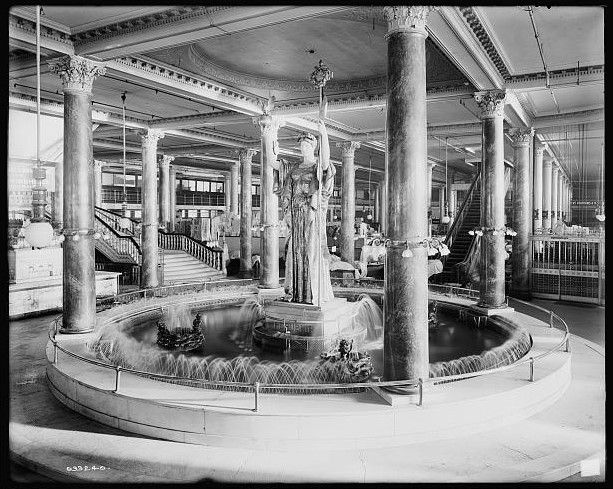
If this machine was initially to be known as the Fountain typewriter, and Siegel-Cooper & Company was to be the exclusive vendor in the United States, the Commercial Typewriter Company may have preferred new customers to contact the vendor directly. Siegel-Cooper & Company published what looks like the first official newspaper advertisement on October 23, 1898, in The New York Times (Siegel Cooper Co., 1898). The name seems to be the perfect fit for a company whose slogan was “Meet me at the fountain”, referring to the beautiful fountain located on the main floor of their New York store. As per the ad, the first Fountain typewriters were to be sold in a special typewriter section located on the main floor “just back of the fountain”. Like many new typewriters at that time, it too was marketed as a high quality machine, equivalent to the standard $100 models, but at a less expensive price.
Siegel-Cooper & Company


Henry Siegel and Frank H. Cooper founded Siegel-Cooper & Co. in Chicago (B.P., 2021) in 1887 (“Siegel-Cooper”, 2025) when the concept of the department store was a new idea. Their store seems to have been the first of its kind in the US, and eventually would compete with department store giants such as Sears & Roebuck, Montgomery Ward, and Macy’s. Misters Siegel and Cooper were influenced in 1893 by the concept of a monumental building to hold department store goods. While the Chicago building was quite large, apparently it was not as attractive as they wanted. They decided to build a “Big Store” in New York, which opened in 1896 (“Siegel-Cooper”, 2025). Big was not sufficient to describe the department store; it was the largest department store in the world at the time, covering a full city block, and looming six stories tall (Miller, 2010). They seemed to offer everything, including a live baby elephant that sold within 2 weeks of opening day (B.P., 2021). Besides merchandise, the store offered various services such as doctors, dentists, a post office, and the sale of theater tickets. As you can imagine, such a huge store would have a huge need for utilities; the basement housed its own plant to ensure they had sufficient power and heating (Miller, 2010). Upon entry of customers into the New York store, the first view would have been of a great marble fountain, ornately decorated, which led to the slogan the company later used, “Meet me at the fountain” (Siegel-Cooper Co., 1898, pp. 25 & 81), and from which our typewriter took its first name.

At the time, The store was one of the first, if not the first, to employ separate employee and customer elevators. This was one of the features advertised as a benefit, apparently so that customers would not see children running up and down the stairs of the store, that is, children that Siegel-Cooper & Company employed among their 3,000 employees. They were proud of the fact that their children were provided two hours of school in the store’s classroom every day (Miller, 2010). It would not have been uncommon to see child labor at that time in New York City; however, compared with today’s standards, the image of children running up and down hidden employee staircases instead of a playground, or sitting in a company room for a couple of hours, instead of a classroom for a school day, is a bit shocking. It is in reading these past norms and contrasting them with our world today that one can reflect upon the progress our forefathers fought for and won in the last 100 years. Such pauses are critical at times when progress is challenged to ensure that we don’t forget that it is only through constant vigilance and action that we can prevent unnecessary hardships and injustice from becoming the norm once again.

By November 15, 1898, the typewriter department in the New York store moved upstairs to the third floor (“Fountain Typewriters”, 1898), likely to make room for some new featured product. Five days later, the Chicago store announced that it would start selling the Fountain from its own typewriter department (“$35 Typewriters”, 1898), thereby opening the product in two of the largest markets in the United States.

This initial partnership with Siegel-Cooper & Company as an exclusive vendor of the Fountain seems to have been fruitful, but was not without risks. There were critics of the department store model who indicated that such stores were successful because they were, in fact, giant trusts. The typewriter world was familiar with trusts and their critics. In 1893, the Union Writing Machine Company was formed out of the merger of Smith Premier, American Writing Machine, Remington, and Yost Writing Machine Companies (Davis, 2007). One of the most well-known outcomes of this merger was the ability to set the price of standard typewriter model at $100. This meant that the companies did not have to worry about undercutting each other with lower prices in an attempt to gain market share, but it also meant that customers may have been paying higher than market value, and likely higher than labor value, for each machine. But does a department store have the same capabilities as a trust to ignore the ability of the free market to regulate fair prices? Siegel-Cooper & Co. certainly did not think so. They placed an ad that read: “the department stores are the implacable foes of trusts . . . the Department Store is nothing more nor less than a general country store adapted to the wants of a large city” (“$35 Typewriters”, 1898). And in fact, department stores are set up to sell the same product from multiple companies on the same shelf, putting the products in direct competition. That said, price setting in a department store would not come from various companies agreeing with each other, as it does in a trust, but rather both prices and the choice of vendors could be dictated by the store itself. Add to this the ability for the store to brand and directly price its own product lines, and it starts to feel again more like a trust or a monopoly than a country store, so the jury is still out.

Summary of Part I: The Beginning
And here we will pause the story. In Part I of Chronology of the Commercial Visible Typewriter, we met Richard Uhlig and discovered he was not only the inventor of the Commercial Visible, but also the supervisor and Vice President of the factory that produced the Commercial Visible, The Commercial Typewriter Company. We also met William Bell Baldwin, the entrepreneur who purchased Uhlig’s patents, and in so doing, likely brought about the capital that brought this machine to life. Finally, we saw “The Big Store” of New York, Siegel-Cooper & Company, which was the first vendor of the Commercial Visible aka Fountain typewriter. In Part II of Chronicles of the Commercial Visible, we will explore a second machine, the Index Visible, and will learn of its connections to the Commercial Visible.
References
Due to the length of the reference list for this six part series, it has been posted separately. Please see the article titled "Chronicles of the Commercial Visible, References" for a complete list of all sources you will encounter in the text, and from which the pictures were pulled.


Comments